Sunday, August 11, 2013

Fuzi with a bacon and garlic sauce


Fresh pasta just has a different feel and tenderness. And with the freedom to shape it as you wish, it adds a textual lift to any pasta dish. I haven't tried shaping pasta before, so the fuzi that I've made here are a little misshapen, but they make for a lovely lunch, especially with a simple bacon garlic sauce. I remember seeing these made in Anthony's Bourdain's fishy feast around Istria, and when dressed with white truffles and cream, they looked delectable. Fresh pasta is typically served up with a thick sugo of chicken and game meats, but I'm not a big fan of heavy meaty sauces for lunch.

I've used smoked bacon in this dish, but it can just as easily be substituted with mushrooms. Also, I rolled and cut these out by hand, and thus they've ended up in a little  varied in size. 


Ingredients

Pasta
  • 1 cup whole wheat
  • 1 cup semolina or hard wheat flour
  • 2 eggs
  • Water
Sauce
  • 2 rashers of bacon, chopped
  • 1/2 cup milk
  • 1/2 tsp paprika
  • 2 cloves garlic, chopped
  • 1/2 tbsp olive oil
Method

Pasta
  1. Mix the eggs, wheat and semolina together and add a little water to make a soft dough. Leave aside to rest for 30 minutes.
  2. Roll out the dough into a thin sheet and cut out 1-1.5 inch squares.
  3. Take one pair of opposing corners of a square and pinch it together, leaving a . An alternate folding style is to cut the square along the diagonal to create two triangle, and pinch the three edges together at the top to create a little cap. 
  4. Boil the pasta in salted water till its just cooked. Add a little vegetable oil and rub it into the pasta to keep it from sticking.
Sauce
  1. Heat the oil in a pan, and add the bacon. Crispen the bacon and add the garlic. 
  2. Keep stirring to prevent the garlic from burning. Cook until the garlic releases its aromatic oil, and add the milk.
  3. Reduce the heat, add the paprika and salt to taste. Let the sauce stew for 2-3 minutes to let the flavours meld together.
  4. Add the pasta, and toss around. Serve up hot and right off the stove.


Saturday, August 10, 2013

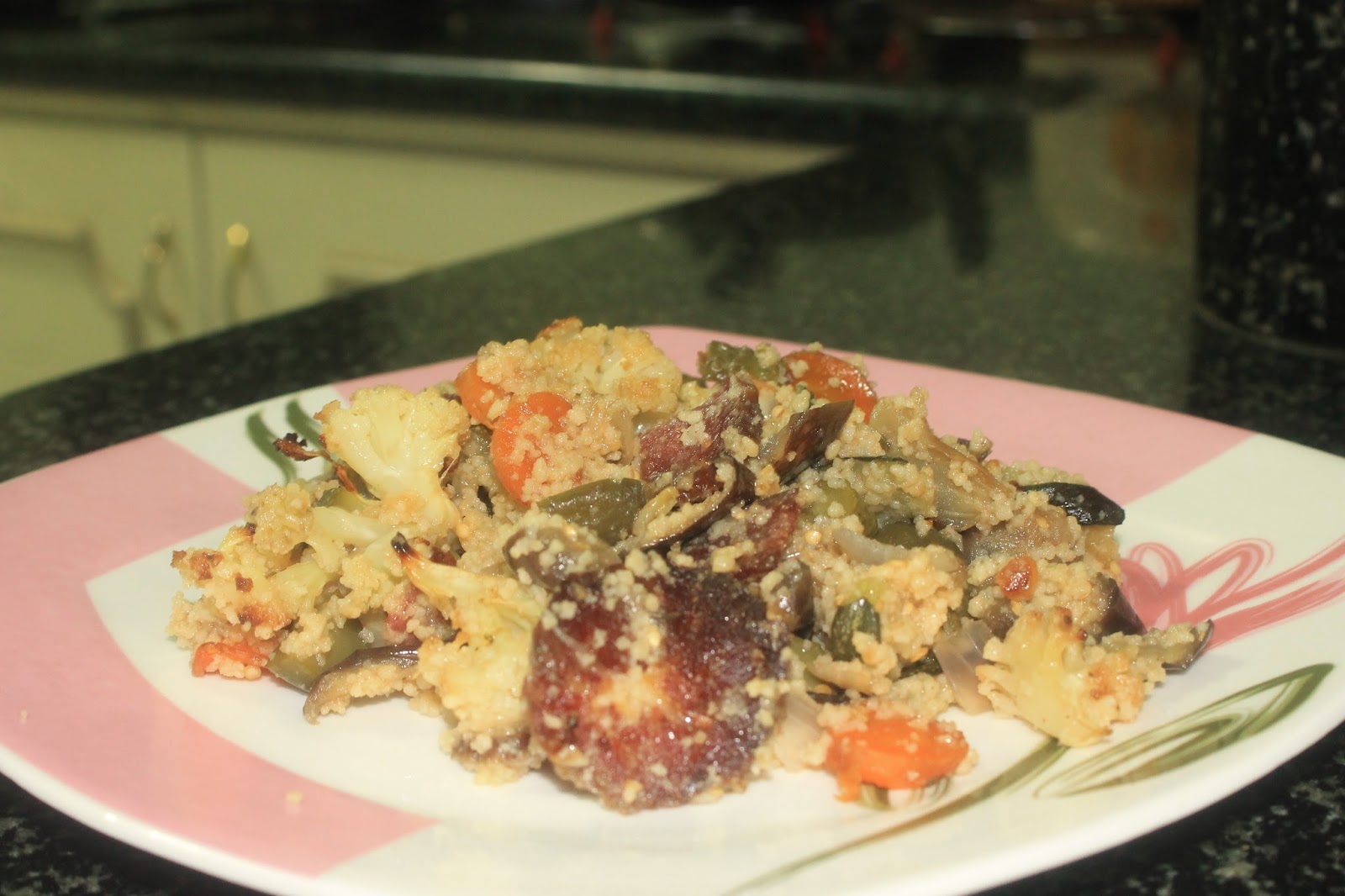
Roasted Vegetables with Couscous


Couscous is such a wonderful ingredient; its light and airy.  It also makes for an excellent palette for the melding of flavors and binds the many parts of the dish together. I've made this salad with roasted vegetables, as roasting given them that extra bit of punch, and I love a bit of charing around the edges. This salad is simple enough and requires little attention, as its just a matter of prepping the vegetables and leaving them to roast in the oven. I've also added some Hungarian smoked sausage, as it adds a different texture and some smokiness, but you can use any bacon or chorizo as a substitute, or omit it altogether for a vegetarian version.

Ingredients
  • 4-5 thin slices of smoked Hungarian sausage, quartered
  • 1/2 red onion, roughly chopped
  • 1 carrot, roughly chopped
  • 1 aubergine, cut into thick cubes
  • 1/2 zucchini, cut into thick match-sticks
  • 2-3 florets of cauliflower, split along the stem
  • 3 pickled gerkins, roughly chopped
  • 1/2 cup uncooked couscous
  • 1 cup low sodium chicken stock
  • 1 tsp dry rosemary
  • 1 tbsp olive oil
  • juice of 1/2 a lemon
  • salt and pepper to taste
Method
  1. Pre-heat the oven to 200C/gas mark 6.
  2. Add the sausage, onion, carrot, aubergine and cauliflower in a roasting pan. Add the oil and rosemary and toss around to get the oil to evenly coat the vegetables. Sprinkle on some salt and pepper. Add a little extra salt as it'll make the vegetables a little bit crisper and will be balanced out by the couscous.
  3. Place the roasting tin in the oven and leave it in there for 40 minutes. Turn once at 20 minutes, but otherwise leave it alone.
  4. Heat the chicken stock till it starts boiling. Add the boiling stock to the couscous, cover and leave aside.
  5. Once the couscous has cooked, add the gerkins.
  6. Once the roastings done, remove from the oven, add the couscous to the mix and toss the mixture around.
  7. Leave it covered for a minute, as it will allow the couscous to absorb the roasting juices.
  8. Plate up, add a splash of the lemon juice and serve up. 


Saturday, July 27, 2013

Awadhi Ghost Biryani


Wonderfully fragrant and lightly spiced, I love awadhi biryani and have been looking to make it for quite some time. This style of biryani has its origins in the kitchens of Lucknow, the erstwhile capital of the kingdom of Awadh, and is distinguishable form other styles by the melding and light use of spices and heavy use of aromatics like Kewra extract and rose water. I've also added mint as I love its wonderful fragrance when baked. 

The fragrance of the biryani is also enhanced by its cooking style, where it is cooked on a low flame in a sealed container to seal in the flavour and aroma of the ingredients.

A word of warning, the preparatory time for this biryani is upwards of 2 hours, as it has a number of components that need to be separately prepared and assembled together just before the last round of cooking.  

I used mutton for this biryani, as its the preferred meat in awadhi cooking, but this can just as easily be made with chicken, with suitable variation in the cooking time, or with boiled eggs or vegetables, with the use of stock cubes for the savoury broth.


Ingredients

Meat Marinade and Gravy
  • 500 g mutton, with bones and cut into bite sized chunks
  • 2 medium onions, one finely chopped and other cut into thin longitudinal slices
  • 3 cloves garlic, chopped
  • 1" ginger, chopped
  • 3 cloves
  • 5 peppercorns
  • 1" cinnamon
  • 1 tsp coriander powder
  • 1 tsp cumin
  • 1 tsp turmeric powder
  • 2 dry red chilies, chopped
  • salt to taste
  • 1/2 cup plain yogurt
Rice and Savory broth

  • 2 cups basmati rice, washed
  • 5 cloves
  • 1 star anise
  • 1" cinnamon
  • 2 bayleaves
  • 8 peppercorns, cracked
  • 3 black cardamoms, slit
  • 1 small piece of nutmeg
  • 2" ginger, sliced
  • 2 tbsp ghee (clarified butter)
  • salt to taste
Garnish
  • 1 medium onion, thinly sliced longitudinally
  • 4-5 cashew nuts, roughly chopped
  • 4-5 almonds, roughly chopped
  • 1/4 cup fresh mint leaves, roughly chopped
  • 1 tbsp ghee (clarified butter)
Aromatic milk
  • 1/2 cup milk
  • 3 green cardamoms
  • 3-4 strands of saffron
  • 1/2 tsp kewra extract
  • 1/2 tsp rose water
Method

Mutton Marinade

  1. Crush the dry spices in a mortar and add it to the chopped onion, garlic and ginger. Add the yogurt and make a thick marinade. Add around a 1 tsp of salt.
  2. Add the mutton pieces to the marinade, and toss around to make sure that it evenly coats the mutton.
  3. Leave in the fridge overnight, or for at least 6 hours.
Savoury Broth
  1. Place all the spices in the middle of a cheesecloth and tie its ends together to create a spice pouch.
  2. Take the mutton pieces out of the marinade and keep the marinade aside.
  3. Heat 1 tbsp of ghee in a pressure cooker and add the mutton pieces. Brown the pieces on all sides and add 3.5 cups of water. In case you don't have a pressure cooker, use a heavy bottomed pan and cook with a lid. Also add an extra half cup to a cup of water, to ensure that you have 3.5 cups of the savoury broth after cooking the mutton.
  4. Add the spice pouch and close the pressure cooker. Cook for 8-10 minutes until the mutton is tender and falling apart.
  5. Separate the mutton pieces and the savoury broth using a sieve. Remove the spice pouch. The spice pouch can be thrown away, or dried out and used for spicing soups.
Mutton Gravy
  1. Heat a tbsp of ghee in a heavy bottomed pan and add the sliced onions and brown on high heat. 
  2. Add the marinade and cook until the oil starts to separate.
  3. Add the mutton pieces and 1/2 cup of the savoury broth. Toss around lightly to create a thin gravy.
Aromatic Milk
  1. Crush the cardamom pods lightly. 
  2. Heat the milk and add the crushed cardamom.
  3. Bring to a boil and remove from the heat.
  4. Crush the saffron and add it to the milk. Stir it into the milk, cover and leave aside to cool.
  5. Stir periodically to prevent the cream from separating.
  6. Once cool, add the kewra extract and rose milk and keep covered.
Garnish
  1. Dry roast the chopped almond and cashew, till the pieces are lightly tinged with brown specks.
  2. Heat a tbsp of ghee in a heavy bottomed pan and add the onions. Brown the onions on high heat, and leave aside to cool.
  3. Once the onion has cooled, add the roasted almonds and cashews and the chopped mint.
  4. Toss around to evenly distribute the ingredients.
Rice
  1. Heat 1 tbsp of ghee in a pan with a lid. Add the washed rice and stir around until the rice glistens.
  2. Cook on high heat till the rice turns opaque.
  3. Add the savoury stock, reduce the heat and cook covered for 10 minute, or until the rice absorbs the stock.
  4. Take off the heat and keep aside, covered, for ten minutes.
Assembling the Biryani
  1. Take an oven proof bowl with a tight fitting lid.
  2. Pre-heat the oven at 220 C/gas mark 7.5
  3. Add half the rice to the bowl and flatten it out. 
  4. Pour half the aromatic milk over, in a circular pattern.
  5. Add the mutton gravy and spread it to create a mutton layer.
  6. Add the half the garnish and spread it out.
  7. Cover with the remaining rice and flatten out.
  8. Pour in the remaining aromatic milk in a circular pattern, and spread the remaining garnish. Close the bowl and place in the pre-heated oven, at 220 C/gas mark 7.5
  9. Let it cook at 220 C for 10 minutes and then lower the heat to 120 C/gas mark 4 for 15 minutes.
  10. Once done, take it out of the oven and let it rest for 10 minutes.
  11. Carefully remove the lid and let those wonderful aromatics tease your senses. Serve   up with a raita of yogurt and cucumber and onions.


Sunday, July 21, 2013

Jenji Gaasi


Sweet crab and a spicy coconut gravy; it shouldn't work, the spices should overpower the delicate flavour of the crab...bah that rubbish, this is wonderful and easy way of cooking crab, with the coconut base balancing out the sweetness and the spice to create this wonderful chemistry of flavour. This is a Manglorean dish and is best had with plain streamed rice. I love crab, especially cutting into it and extricating that wonderful meat. I also prefer to cook it with the shell, as it protects the meat from the heat through the slow cooking process. The dish takes around 40 minutes of preparation and 20 minutes of cooking.

Ingredients
  • 250 g blue crab, cleaned and cut into large chunks
  • 1 medium onion, finely chopped
  • 1 inch ginger, roughly chopped
  • 2 cloves garlic, roughly chopped
  • 1 medium tomato, chopped into large chunks
  • 2 red chilies, reconstituted in hot water
  • 1 thumb sized piece of tamarind
  • 1 tsp fenugreek seeds
  • 1 1/2 tsp coriander seeds
  • 1 tsp cumin seeds
  • 6 peppercorns
  • 1 star anise
  • 1/2 cup shredded coconut
  • 1/2 tsp turmeric powder
  • salt to taste
  • 1 tbsp vegetable oil
  • 1/2 cup water
Method
  1. Wash the crab, and sprinkle with salt and turmeric. Be restrained with the salt, as the crab will naturally be a little salty. Rub the turmeric and salt into the crab chunks.
  2. Dry roast the peppercorns, coriander sees, star anise and cumin together, until they release their aroma. Keep stirring it around to prevent the cumin from burning.
  3. Add the roasted spices to the ginger, garlic, fenugreek seeds, red chilies, coconut and tamarind, add a little water and grind into a thick and smooth paste.
  4. Heat the oil in a pan, and add the onions. Fry until translucent.
  5. Add the tomatoes and fry till it softens.
  6. Add the ground paste and stir around. Cook the paste until the oil starts to separate.
  7. Add the crab pieces and toss around so that the paste covers the crab. Add the water and salt to taste and cook covered for 8-10 minutes, till the crab cooks through.
  8. Once done, take off the heat and let it rest for a few minutes.
  9. Serve up over a base of plain rice.


Saturday, June 22, 2013

Pizza Bianca with Three Cheeses


While Neapolitans rejoice at their hand in the creation of the traditional pizza, Romans take heart in their own variant of the pizza, the Pizza Bianca. This is a popular street snack, and is essentially lean bread topped with rosemary and olive oil. For sometime a little more substantial, I added jalapeños and tomatoes and topped it with a mixture of three cheeses, gouda, mozzarella and cheddar. I've also added some olive oil to make it softer. The recipes amounts here will make two 9" pizzas.

Ingredients
Base

  • 3 cups plain flour
  • 1 tsp dry yeast
  • 4 tsp sugar
  • 1/2 cup warm water
  • 1tsp salt
  • 3 tbsp olive oil
Topping
  • 2 tomatoes, roughly chopped
  • 2 tbsp jalapeños, chopped
  • 2 tbsp each of grated mozzarella, gouda and cheddar
  • 1 tsp salt
  • 3 tbsp olive oil
  • 1 tbsp dried rosemary
  • 1 tbsp dried basil
Method
  1. Dissolve the yeast in the warm water with some sugar. Leave aside to bubble up and activate.
  2. Mix the activated yeast with the rest of the Base ingredients to make a soft dough. Leave aside in a warm place to proof.
  3. Once it proofs, pre-heat an oven to 210 degrees C/gas mark 7.
  4. Split the dough into two parts and roll it out into two thin rounds, about half an inch in width. Stretch it by hand and create light indentations on the surface.
  5. Place the dough on a well oiled baking tray or iron griddle pan.
  6. Drizzle some olive oil onto the dough and spread it to evenly coat the dough.
  7. Sprinkle on the toppings evenly, dab some olive oil on the crust and place in the hot oven.
  8. Bake for 20 minutes, until the crust turns a light brown and the cheese is bubbling and golden.
  9. Remove and set it rest for 2 minutes before serving.

Sunday, June 9, 2013

Oven-roasted Crab with Herb Butter


I love the salty and sweet flesh of fresh blue crabs, especially when served with a herb butter sauce as it accentuates the sweetness of the flesh. Its a little work to get through to the flesh, as blue crabs are typically much smaller than Dungeness or mud crabs, but its well worth it. Ive served this up with some herb fougasse, to soak up the butter sauce, but any sourdough or a dense bread will do. I've also used cleaned and cut crabs, as I prefer to let my fishmonger handle the nasty business of cutting through the top shell and removing the gills and tomalley. The herb fougasse recipe can be found at: Herb Fougasse.

Ingredients
  • 2 blue crabs, cleaned and split down the middle
  • 3 tbsp herb butter (with garlic, coriander, basil and pepper)
  • 2 cloves garlic, chopped
  • 1 tsp paprika
  • salt and pepper to taste
Method
  1. Add the paprika and a little salt to the crab pieces. Crack the claws and toss it around to have the rub coat the crab evenly. Set aside for an hour.
  2. Melt the herb butter in a pan on low-medium heat, and add the garlic. Fry lightly to release its aroma, but be careful as to not brown the butter.
  3. Add the crab pieces, lower the heat and toss it around so that the butter evenly coats the crab pieces. Add a little salt and pepper to taste; watch the salt though as the crab and butter have a little salt in them.
  4. Place in an oven-proof dish, and place in a preheated oven at 240 degrees C/gas mark 8 for 15 minutes.
  5. Add a dash of lime and serve the crab with the butter sauce dribbled over.

Herb Fougasse


A beautifully formed Provençal bread can be made plain with a topping of poppy and sesame seeds, or with a rosemary onion topping. Its a light and versatile bread that's a great accompaniment to soups or to mop up a gravy and its a fairly flat bread so can easily be stored away. The bread has a very light crust and can be cut into a number of other patterns. I used dry rosemary, chopped tomatoes and stewed onions to top, and kneaded some of the onion into the dough.

Ingredients

  • 3 cups flour (I used 2 cups of white flour with 1 cup of wholewheat flour)
  • 1 tbsp dry yeast
  • 1 cup water, warm
  • 2 tsp sugar
  • 1 tsp salt
  • 3 tbsp olive oil, and a little more for brushing
  • 1 tbsp dry rosemary
  • 1 red onion, thinly sliced
  • 1 medium tomato, chopped into large, rough chunks
Method
  1. Dissolve the yeast and sugar into the warm water, and leave aside to activate.
  2. Add the activated yeast to the flour, mix in the salt and 2 tbsp of olive oil and make a soft dough.
  3. Leave the dough aside in a warm place to rise and double in size. It should take an hour or so.
  4. Heat the olive oil in a pan and add the onions, stew them until they start to brown around the edges. Add the rosemary and take it off the heat.
  5. Add half the onion-rosemary mixture to the dough and knead it into the dough. Add a sprinkling of flour if it seems a little too wet.
  6. Roll the dough out into a thick rectangle, and take a knife or dough cutter and make a single incision down the middle of the rectangle. Leave at least an inch from the incision to the short edge of the rectangle. Make three more incisions on each side of the middle one, equally spaced, and an inch from both the long edge and the middle incision.
  7. Pick the dough up and lightly set it down, to open up the incisions. Brush the top lightly with olive oil and add the remaining onion-rosemary mix and the tomatoes to the top. Leave aside in a warm place to proof, for at least an hour.
  8. Once risen, place in a pre-heated oven at 240 degrees C/gas mark 8 for 15 minutes.
  9. After 15 minutes, lower the heat to 180-190 degrees C/gas mark 6 and let it cook for another 15 minutes, for it to develop a light brown crust.
  10. Let it cool before slicing. Serve it with a sweet relish or with garlic-parsely butter, to cut through the bitter onion and rosemary.