Barley has this wonderfully comforting chewiness which makes it an excellent substitute for starchy arborio or calaspara in either risottos or paella. It also carries the tag of being a super food, which helps obviate the guilt. Processed barley comes in two forms, hulled barley and pearl barley. Hulled barley retains the outer husk and while being rich in fiber has a chewy almost fibrous texture and extended cooking time that makes it a pain to cook with. The more processed form, pearl barley, has the outer husk removed, which makes it look like little white opals. While its less rich in fiber, it has a milder and more palatable flavour while retaining its super-food levels of selenium and protein. The mild flavour and chewy texture makes it an excellent substitute for short-grained rice or pasta or to add body to stews.
Processed barley is almost always dried and packaged, and thus before cooking, the grains need to be soaked in plenty of water for at least 6 hours but preferably overnight. Once this is done, the cooking time reduces to 15-20 minutes from the 45 otherwise.
Ingredients
- 1 cup dried pearl barley grains, pre-soaked for at least 6 hours
- 3-4 slices of chorizo or other cured sausage, chopped
- 1/2 green capsicum, thickly sliced
- 8-9 small prawns, cleaned and de-veined
- 2 tsp smoked paprika
- 1 tsp saffron dust
- 1 small onion, chopped
- 4 cloves garlic, chopped
- 1 cup warm water
- 2 cups chicken stock
- 1 tomato, chopped
- 1 tsp salt
- 2 tbsp olive oil
- chopped parsley or coriander to garnish
- 1 lemon half
Method
- Heat the stock to boiling and then take it off the heat.
- Add the saffron dust to the cup of warm water and leave it to infuse.
- Heat the olive oil in a thick bottomed pan with a lid. Add the chopped chorizo/sausage, onion and garlic and sweat it down.
- Drain the pearl barley grains and add it to the frying onions. Toss around to coat the grains with the oil and let it cook till the grains turn a little opaque.
- Add the saffron infused water and stir around. Cook on high heat till the saffron water is absorbed by the grain.
- Add the tomatoes, capsicum and paprika and toss around. Add the warm stock and bring to a boil. Once boiling, reduce the heat and cover with the lid.
- Cook the grains on low and covered for at least 20 minutes. At 15 minutes, stir the grains and add the salt and prawns. Then cover and cook for another 5 minutes, or until the liquid is absorbed.
- Once the liquid is absorbed take off the heat and leave aside, covered, to cool and meld together for 5 minutes.
- Add the garnish and squeeze the lime over before serving.
Its been quite some time since I rolled out pasta on the pasta machine, and with some fresh cottage cheese and dill lying at home, this recipe was just calling out to me. The ravioli stuffing a simple salmon and cottage cheese mousse, with a little dill and smoked paprika seasoning. The original recipe called for ricotta, but fresh drained cottage cheese has the same texture and feel. Dill and Salmon are perfect pairs, with the capers adding a nice acidity to the dish. The ravioli requires most of the leg work, and they can be made in advance and frozen in batches. This recipe used one cup of flour, and made nine raviolis, which is enough for one person.
Ingredients
Ravioli
- 1 cup wheat flour
- 1 egg
- 2 tbsp flour for dusting
- 1/2 cup fresh drained cottage cheese
- 1/2 cup flaked pink salmon
- 1 tbsp chopped dill
- 1 tsp smoked paprika
- 1 tbsp olive oil
- 2 tsp salt
- 1 tbsp water mixed in with 1 tsp flour
- Salted water with tsp of vegetable to boil the ravioli
Dill Caper sauce
- 1 cup milk
- 1 tbsp butter
- 1 tbsp caper
- 1 tbsp chopped dill
- 1 tsp salt
Method
Ravioli
- Mix the flour, egg and salt and make a soft dough. Wrap in cling-film, and keep in the fridge for at least an hour.
- Blitz the salmon, cottage cheese, dill, oil, salt and paprika to make a thick smooth mousse. Keep it thick as its easier to handle and stuff in the ravioli.
- Roll out the dough on a pasta machine, till the eight setting. Cut out circles of 2 inch diameter.
- Spoon a teaspoon of the salmon cheese mixture into the centre of one circle, baste the edges with the water-flour mixture and place a second circle on top. Press down the edges to seal the ravioli, and place on a lightly floured board.
- Once the ravioli cases are made, bring a pot of salted water to a boil and add the ravioli cases. Avoid over-loading the pot, and limit it to three ravioli cases per round.
- Boil for a minute each, until the ravioli cases float up and are cooked through.
- Remove and keep aside in an oiled strainer.
- Heat butter in a pan, and once it starts frothing, add the capers and dill. Lower the heat and let it steep for a minute. Then add the milk and salt and bring to a boil.
- Add the ravioli and spoon the sauce over. Bring to a boil and take off the heat.
- Serve up with a slice of lime.
Gulyas, or Goulash, this iconic Hungarian stew has far too many variations to count, and the only thing that really ties them together is the smoky-sweet paprika that gives it its characteristic rich red colour. The stew's name 'Gulyas' means 'Hunter' in Hungarian, a reference to its origins as a herdsman/hunter's meal and it is best made with off-cuts of red meat (like beef or mutton) or game meats (like rabbit) and hearty vegetables like potatoes and carrots. A vegetarian version is also possible with the use of broad beans or kidney beans in place of the meat. Goulash has a lengthly cooking time, with the meat braising in its cooking liqour for upto an hour and half, and thus off cuts and muscular cuts should be used, as they add a wonderful gamey flavour to the stew.
Another tip to reduce the cooking time is to use a pressure cooker, as it reduces the braising time to a mere 15 minutes. For this Goulash, I've used boneless mutton cubes and smoked paprika, and added a little kashmiri paprika for a bit of heat. The recipe has been adapted from recipe on thehungarydish.com: http://www.thehungarydish.com/the-best-gulyas-recipe, which is an excellent site for traditional Hungarian classics, like Lecso and Slambuc. I've served up the Goulash with plain rice, and it can be served up on a bed of pasta or polenta, or with chunks of crusty bread or a Hungarian pasta called Csipetke.
Ingredients
- 200 g boneless mutton, cleaned and cut into bite sized pieces
- 1 large white onion, thinly sliced
- 2 cloves garlic, chopped
- 1 large tomato, roughly chopped
- 1 medium potato, cubed
- 2 medium carrots, roughly chopped
- 1 tsp cumin seeds or 1 tbsp caraway seeds, lightly roasted
- 3 cups water (use 5 cups if not using a pressure cooker)
- 1 tbsp smoked paprika (or sweet paprika)
- 2 tsp kashmiri paprika (or hot paprika)
- 1 tbsp vegetable oil
- 1 tsp black pepper powder
- Salt to taste
Method
- Rub a tsp of salt and the pepper into the mutton and leave aside for at least 30 minutes.
- Heat a the oil in thick bottomed pot or a cooker bottom, and once hot, add the sliced onions. Add a tsp of water as well, to prevent the onions from browning. Lower the heat and stew the onions for at least 10 minutes, until they turn clear and glassy.
- Take off the heat and add the paprikas, cumin/caraway seeds and another tsp of water to prevent the paprika from burning and turning bitter. Mix around till the paprika evenly coats the onions, and place back on the heat.
- Raise the heat to high and add the mutton and garlic. Cook on high till the mutton turns brown and add the water. Stir vigourously and bring the stew to a boil. Once boiling, close the pressure cooker, and once the pressure its pressurised (when its on the verge of whistling or whistles once) lower the heat.
- Cook on low for around 10 minutes, around 2-3 whistles, and then turn off the heat. Leave the pressure cooker aside and let it de-pressurise and cool naturally, which should take another 6-7 minutes.
- Once its de-pressurised, remove the lid and check the salt and the consistency of the stew. Make sure to keep it a little under-salted as the excess water in the stew will be burnt away.
- The stew should be quite thin and runny, so place back on the heat uncovered and bring it to a boil. Add the potatoes, carrots and tomato and cook on high heat for another 10-12 minutes, until the potatoes are just done (everything else will cook before the potatoes). While cooking the potatoes, keep the stew uncovered until you get the desired consistency, and cover for the remaining time. I like my stews to be quite thick, so I kept it uncovered for the entire cooking time.
- Take off the heat and serve over an absorbent base, like rice or poleta, or with thick crusty bread.
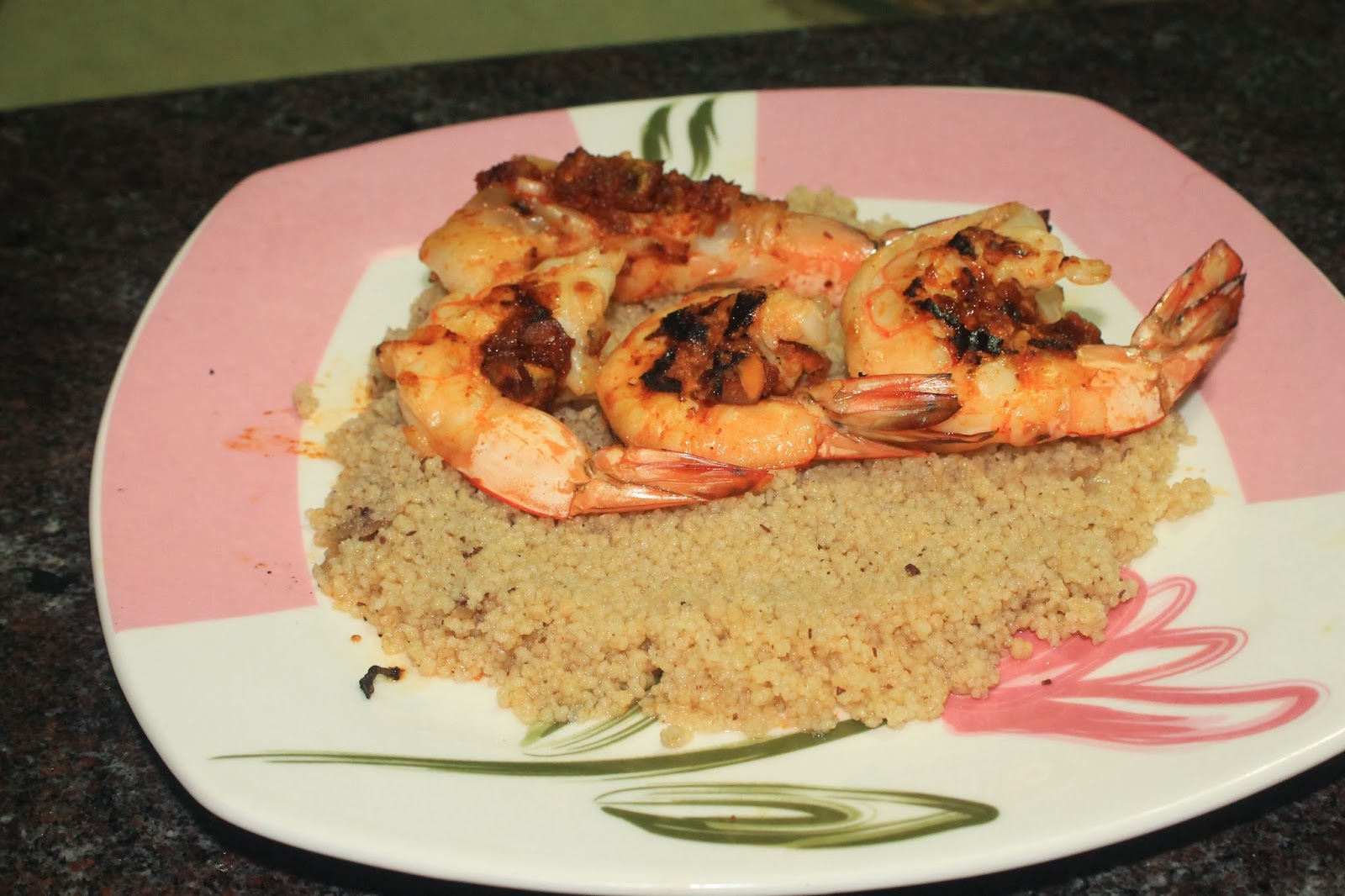
Found these enormous fresh and juicy prawns at my fish monger's today, and jumped at them. I've always felt grilling shows off the flavours of ingredient, and to add a little punch, I stuffed the prawns with some tangy pesto rosso (red pesto) and pistachios, and served it up on a bed of lemony coucous. Stuffing is really easy with large meaty prawns, and is a great way of playing with flavours and getting that balance. In this, the pesto rosso adds sourness and the pistachios a light sweetness, with a light smokiness through smoked paprika. I also added a little garlic, for its wonderful pungency. The base was a simple mix of couscous with preserved lime and sumac.
Ingredients
- 6 large prawns, cleaned and deveined (with the tail on)
- 3 tsp pesto rosso
- 8 pistachios, chopped
- 2 cloves garlic, chopped
- 1 tsp dried oregano
- 1 tsp salt
- 1 tsp smoked paprika
Method
- Clean and pat dry the prawns. Rub some salt into the exterior.
- Turn the prawn around, so the underside is facing you. Cut into the underside, till 3/4th through, and slide your knife through from the tail to the head.
- Mix the pesto, pistachios, garlic, oregano and paprika, and take half a tsp of the stuffing and drive it into the cavity that you've made in each prawn.
- Oil a grill and heat to medium. Add the prawns, and cook on each side for around a minute each, until the prawns are cooked and tender, and have turned a light pink on each side.
- Serve up with a garnish of fresh lemon, or with on a bed of lemony couscous.
Pink Perch is such a beautiful fish, with its light pink hue and shimmering skin. It has a firm texture, which makes it an excellent fish to fry, and a slightly sweet flavour. The fish is also quite small and can very This preparation is a Keralite way of making the fish, and generally involves wrapping the fish in banana leaves and frying on high heat. However that's quite a messy process, and the whole fish (with its skin-on) can just as easily be shallow fried in a pan on medium-high.
Ingredients
- 2 whole pink perches, scaled and cleaned
- 1 small onion, finely chopped
- 2 cloves garlic
- 1 inch ginger
- 1 tsp red chilli powder
- 2 tsp turmeric
- 1 tsp salt
- 1 tsp pepper
- 4-5 curry leaves
- 2 tbsp vegetable oil
Method
- Clean and pat dry the pink perch, and make deep slits in fish, on both sides.
- Add the salt and turmeric to the fish and rub into the fish, particularly into the slits.
- Toss the onion, ginger, garlic, pepper and red chilli powder into a pestle and smash down into a thick paste.
- Add the paste to the fish, and rub into the flesh. Leave aside to marinade for an hour.
- Heat the oil in a pan, and once hot, add the curry leaves.
- Once the leaves stop sputtering, add the fish and lower the heat to medium-high.
- Cook on both sides, till the fish is completely cooked through. It should take around 1-2 minutes on each side, depending on the thickness of the fish.
- Serve up, with a squeeze of lime.
Its practically customary at home to crack open a nice wine and sit around the table every Sunday evening. Generally, we have some cheese and crunchy dal-mote with the wine, but today there was a loaf of artisanal bread and plump tomatoes lying in the fridge. So the accompaniment was a fresh tomato and mint bruschetta. With the bread, I grilled it on my grill pan for a nice char and the adding some fresh paneer (cottage cheese) for a little sweetness.
Ingredients
- 1 small loaf of artisanal bread, like a baguette, cut into thick slices
- 3 tbsp olive oil
- 3 tomatoes, roughly chopped
- 4 jalapeños, roughly chopped
- 1 tbsp sherry vinegar
- 2 cloves garlic
- 2 tbsp paneer, crumbled
- 1 small bunch of mint leaves, roughly chopped
- 1 tsp salt
- 1 tsp pepper
Method
- Mix the tomatoes, paneer, 2 tbsp of oil, vinegar, jalapeños, mint, salt and pepper and keep aside for at least 20 minutes.
- Oil the grooves of the grill pan and heat it on medium heat.
- Baste the slices liberally with the remaining olive oil and place on the grill pan. Grill on both sides to crispen the slices and get a nice char.
- Take off the heat and rub a garlic clove into each side. Do this while its still hot as the garlic will melt into the bread.
- Top with the tomato mix and serve up as a light starter or snack.
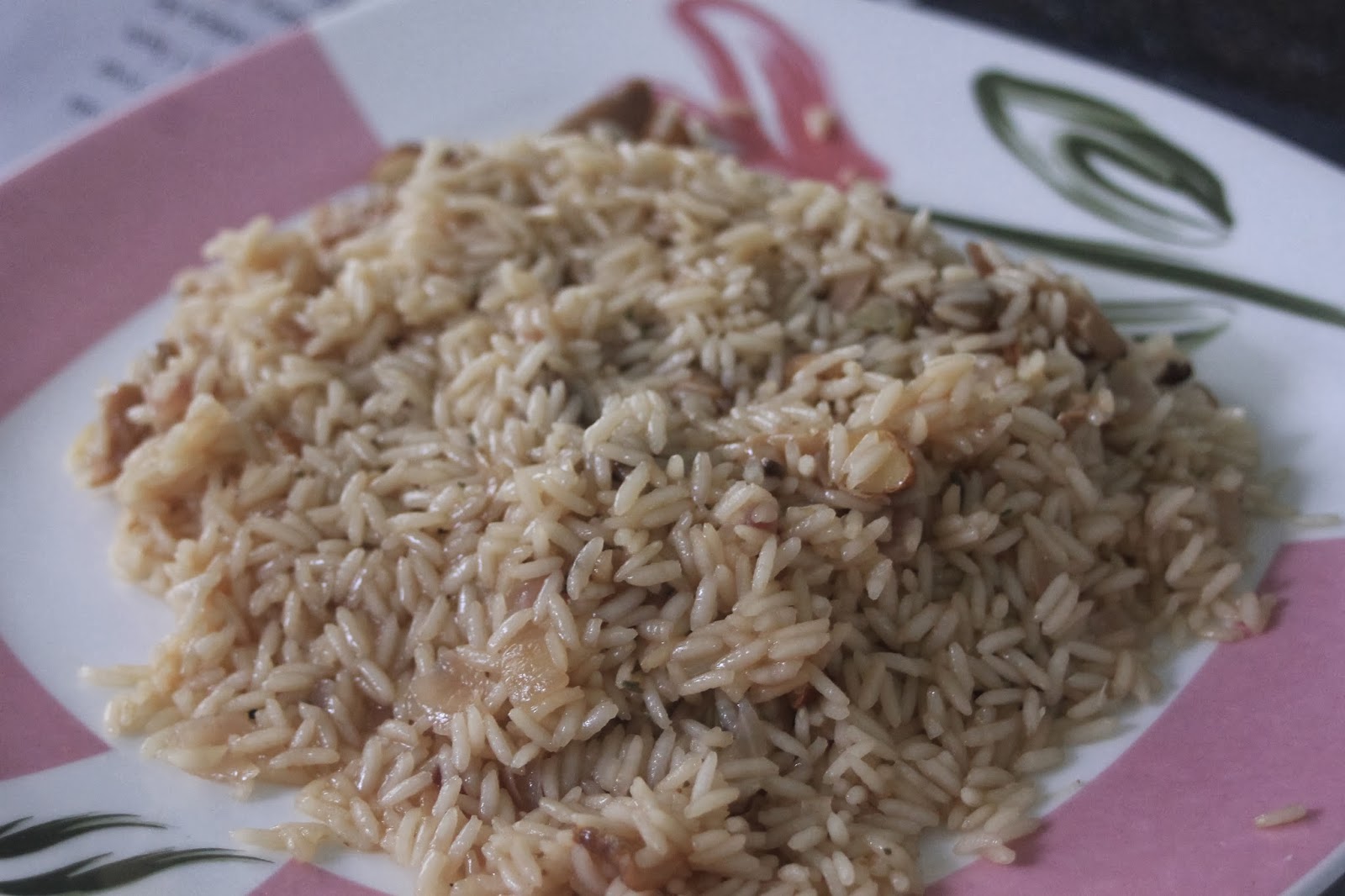
I had some dried prochini and oyster mushrooms left over, but wanted to try something other than risotto. Fresh pasta was an option, but who'd go through all that trouble in making the dough and rolling it out, bleh. So, decided to incorporate them in a light pilaf. The original pilaf recipe was from across the Italian border, a Cèpes Pilaf, with pecans for bite and cranberries for sweetness, which I decided to substitute with almonds and raisins, for a more Moroccan feel.
Ingredients
- 1 cup long-grained rice, washed
- 1 small onion, chopped
- 2 cloves garlic, chopped
- 1 tsp pepper
- 1.5 tsp salt
- 1 bay leaf
- 7-8 almonds, roughly chopped
- 7-8 raisins
- 1 tbsp sherry vinegar
- 1 cup hot water
- 1 cup water
- 2 tbsp dried mixed mushrooms (oyster and porchini)
- 1 tbsp olive oil
Method
- Clean the dried mushrooms in running water. Then add the dried mushrooms and raisins in a bowl with a tight fitting lid, add the hot water and cover. Leave aside to rehydrate for at least 30 minutes.
- Once the mushrooms and raisins rehydrate, chop them roughly and reserve the mushroom liquor.
- Heat the almonds in a pan and lightly roast them. Remove and keep aside.
- Heat the oil in a pan, and add the garlic and onions. Fry until the onions turn translucent.
- Add mushrooms and pepper, and cook on high heat, until the mushrooms dry out.
- Add the rice and stir until it turns opaque. Add the vinegar and stir vigourously.
- Once the rice absorbs the vinegar, add the mushroom liquor and remaining water, and add the bayleaf and salt.
- Cover with a lid and continue cooking on high heat, until the water is completed absorbed.
- Check the rice, it should be cooked through but with some bite at the centre.
- Switch off the heat and leave covered for 10 minutes.
- Serve up immediately.